
Kepler-452b
Discover Kepler-452b's size, orbit, distance, discovery, possible climate, and uncertain status — and why "Earth 2.0" is an oversimplification.
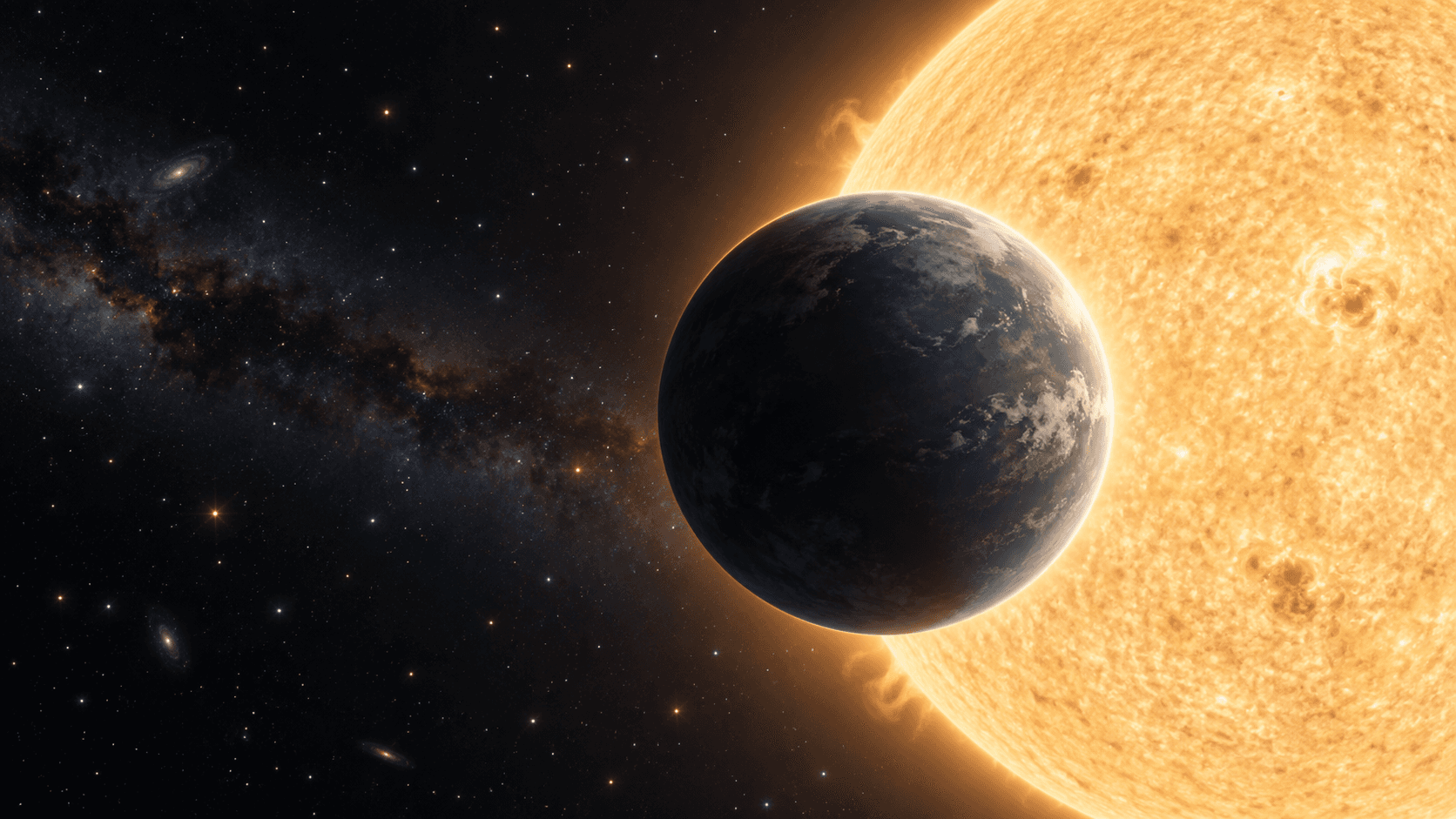
A famous but uncertain "Earth cousin"
Kepler-452b was announced in 2015 as a transiting planet candidate or statistically validated planet roughly 1,400 light-years away, orbiting a Sun-like star every 385 days. Its estimated radius is about 1.6 times Earth's, and its orbit lies within a broadly defined habitable zone. Those similarities produced the nickname "Earth's older cousin." The comparison has strict limits: its mass, atmosphere, density, and surface are unmeasured, and later independent analyses have questioned whether the weak transit signal is robust enough to establish a planet.
The most accurate public article should acknowledge both the historic NASA announcement and the continuing status discussion. Catalog classifications can differ because teams apply different validation thresholds and treatments of instrumental noise. Before publication, check the NASA Exoplanet Archive and original plus reanalysis papers, display the current label, and explain why it may not be final.
How Kepler looked for the signal
NASA's Kepler space telescope stared at a dense field of stars and recorded their brightness. A planet aligned with our line of sight blocks a small fraction of starlight during every transit. Repeating dips with consistent depth, duration, and spacing can reveal an orbiting planet.
Kepler-452b's proposed year is close to an Earth year. During the original Kepler mission, only a small number of its possible transits occurred. The signal was also shallow because a roughly 1.6-Earth-radius object blocks only a tiny fraction of a Sun-size star. Long-period, low-signal detections are harder to distinguish from instrumental artifacts and stellar variability than large planets that cross every few days.
Researchers used statistical validation to estimate whether known false-positive scenarios — such as background eclipsing binaries — could explain the pattern. Validation is not the same as a dynamical confirmation by mass measurement. Later reprocessing can change the noise model, recovered signal strength, and reliability estimate.
Is Kepler-452b confirmed?
NASA described Kepler-452b as the first near-Earth-size planet in the habitable zone of a Sun-like star at its 2015 announcement. Subsequent work re-examined the limited transit data and argued that the signal may not meet a robust detection threshold when systematic noise is modeled differently. Some databases and articles retain it as confirmed; others call it a candidate or disputed object.
This is not evidence that the original scientists acted improperly. Planet detection is an inference from noisy measurements, and catalogs are designed to improve. Long-period candidates are especially vulnerable to small changes because there are few events to average. The page should avoid a flat claim that it was "debunked" and avoid presenting it as unquestioned fact. "Historically validated, with its planetary status challenged by later analyses" accurately conveys the situation until a current archive resolves it.
The host star and orbit
Kepler-452 is a G-type star with similarities to the Sun, though it is older and somewhat more luminous in published estimates. The proposed planet completes an orbit in approximately 385 days at a distance broadly comparable to Earth's orbit. Because the star emits more energy than the Sun, the planet may receive more radiation than Earth despite the similar year.
Stellar age and luminosity matter. As Sun-like stars age on the main sequence, they gradually brighten. A planet can spend part of its history in a habitable zone and later approach a moist- or runaway-greenhouse threshold. Statements that Kepler-452b has spent billions of years in a habitable zone depend on stellar models and on the planet actually existing.
Size does not reveal the surface
The transit depth suggests a radius near 1.6 Earth radii, but no reliable mass has been measured. At this size, known exoplanets show diverse compositions. Some are predominantly rocky super-Earths; others retain water-rich layers or thick hydrogen-helium envelopes and resemble sub-Neptunes.
Without mass, density remains unknown. Without a spectrum, there is no atmospheric composition or pressure measurement. An artist can plausibly show a rocky world, but it must not be captioned as a view of the actual surface. The planet could have crushing atmospheric pressure, deep volatile layers, an overheated surface, or no planet signal at all.
Is Kepler-452b habitable?
There is not enough evidence to say. Its proposed orbit falls in a habitable-zone calculation, but habitability requires a suitable composition and climate. A 1.6-Earth-radius planet may hold a substantial volatile envelope. Its host's higher luminosity could drive strong warming. Clouds, atmospheric circulation, surface water, carbon cycling, albedo, and rotation would determine the result.
If rocky, the planet might have stronger surface gravity than Earth, but that depends on mass. Some modeling studies have explored possible climates under assumed atmospheres. Those simulations answer "what if" questions; they do not measure real oceans, plants, oxygen, or temperature.
The phrase "Earth 2.0" should not appear as a factual label. Similar orbital period and star type are scientifically interesting, yet they cover only a small portion of the properties that make Earth habitable.
Why distance matters
At about 1,400 light-years, the system is too distant for travel with foreseeable spacecraft. Light received now began its journey around the early medieval period on Earth. A radio message would need roughly 1,400 years to arrive and the same time for a reply, assuming a listener and immediate response.
Distance also hampers follow-up. The host is faint compared with nearby targets. Radial-velocity instruments struggle to measure an Earth-to-super-Earth mass on a one-year orbit around such a distant star, and atmospheric spectroscopy would be extraordinarily demanding. That makes the original Kepler light curve unusually important — and limits independent confirmation.
What would be needed to settle the question?
Another observed transit at the predicted time could strengthen the case, but Kepler no longer operates and the target requires suitable telescope coverage and precision. Archival pixel-level analysis can test whether the signal originates at the target star, follows detector effects, or changes under different processing. Independent statistical frameworks can estimate reliability.
Astrometry or radial velocity would be valuable but may lack the required sensitivity for this faint, long-period system. Researchers can also study the broader population: if similar reliable planets are common, the prior probability changes, though population arguments cannot substitute for evidence about one target.
Kepler's broader achievement
Whether Kepler-452b ultimately remains in the confirmed catalog does not erase Kepler's revolution. The mission showed that small planets are common, revealed compact multi-planet systems, measured planet occurrence rates, and supplied thousands of candidates. It also created a public example of how scientific catalogs self-correct.
Kepler's detection pipeline had to balance completeness and reliability. A very strict threshold misses real planets; a permissive threshold admits more false alarms. Occurrence-rate studies model both effects. One marginal candidate can be fascinating, but statistical conclusions depend on a well-characterized sample rather than a memorable nickname.
Comparing Kepler-452b with Earth
Earth's radius, mass, density, atmosphere, oceans, magnetic environment, geology, and biosphere are known in detail. For Kepler-452b, the proposed radius and orbit are inferred from a handful of brightness changes, and stellar properties come from remote observations. The host resembles the Sun more closely than the red dwarfs orbited by many temperate candidates, which is why the target attracted attention.
A near-annual orbit also made the announcement intuitive. But a calendar resemblance does not imply familiar seasons; axial tilt and orbital eccentricity are unknown. A Sun-like star does not guarantee a Solar-System-like architecture. No companion planets are required by the signal, and none should be invented for illustrations.
Could humans live there?
There is no basis for saying humans could live on Kepler-452b. We do not know if there is a solid surface, breathable pressure, liquid water, tolerable gravity, or protection from radiation. Even an exact Earth twin 1,400 light-years away would be unreachable by current propulsion.
Human-habitability framing can be useful if it teaches the constraints, but it should not turn uncertainty into fantasy. The scientifically grounded question is whether the signal represents a planet and, if so, what range of compositions and climates is consistent with its radius, orbit, and star.
Why Kepler-452b still matters
Kepler-452b sits at the intersection of public excitement and detection limits. It motivated people to think about long-lived potentially temperate worlds around Sun-like stars. It also demonstrates why marginal signals need independent testing and why "confirmed," "validated," and "candidate" are not interchangeable.
The story is not a failure if classification changes. Revisiting old data with improved methods is how astronomy becomes more reliable. A transparent page can preserve the wonder while showing readers the process: a tiny dip becomes a hypothesis, multiple false positives are tested, confidence is quantified, and conclusions remain open to revision.
What "validation" means in exoplanet science
Some planets are confirmed by an independent physical measurement, such as a radial-velocity mass or transit-timing interactions with neighboring planets. Statistical validation instead calculates whether planet scenarios are overwhelmingly more likely than modeled false positives. It is powerful, especially when a star is too faint for mass measurement, but its answer depends on the completeness of the scenarios and the quality of the light curve.
For Kepler-452b, the central issue is not simply a background binary. A rare instrumental fluctuation can resemble a very shallow transit when only a few events are available. Reliability studies inject artificial signals, run pipelines on inverted or scrambled data, and count false alarms. If a candidate lies near a detection boundary, small changes to detrending or thresholds can change its disposition.
What the system cannot tell us yet
There is no measured atmospheric spectrum, temperature map, rotation rate, axial tilt, moon, magnetic field, ocean, or biosignature. Search snippets often turn assumed values from simulations into "facts." Keep a compact facts table with a status column: measured, derived, modeled, or unknown. This presentation helps readers see why radius and orbit support an interesting hypothesis but not a portrait of daily conditions.
If the object is recovered in future data, the next priority would be refining its radius and star. Even then, atmospheric characterization at this distance may remain beyond current facilities. Kepler-452b is therefore as much a lesson in survey statistics as a target for planetary climate.
For search accuracy, the opening facts box should use "candidate/status debated" unless the current catalog explicitly supports a stronger label. Add a short update note whenever the disposition changes so old social posts and search snippets do not silently override the evidence shown on the page.
Frequently asked questions
How far away is Kepler-452b?
The proposed system is roughly 1,400 light-years from Earth; published estimates have uncertainties.
Is Kepler-452b confirmed?
It was statistically validated and announced as a planet in 2015, but later analyses challenged the low-signal detection. Check the current NASA archive and describe the status transparently.
Is Kepler-452b habitable?
Unknown. A habitable-zone orbit is only one requirement, while mass, composition, atmosphere, water, and climate are not measured.
Is it bigger than Earth?
The candidate radius is estimated at about 1.6 Earth radii. Its mass and density are unknown.
How long is a year there?
The proposed orbital period is about 385 Earth days.
Can we travel to Kepler-452b?
No present or planned human spacecraft can cross roughly 1,400 light-years.
Compare featured exoplanets
These six featured worlds sample very different corners of the exoplanet catalog. Distances, masses, and interpretations come from evolving datasets, so treat each row as a snapshot rather than a final answer.
| World | Type | Distance | Orbital period | Notable for |
|---|---|---|---|---|
| TRAPPIST-1 system | Seven Earth-size rocky worlds | ~40 light-years | 1.5 – 19 days | Compact resonant chain; benchmark JWST atmosphere study |
| Proxima Centauri b | Roughly Earth-mass candidate | ~4.24 light-years | ~11.2 days | Closest known exoplanet; active red-dwarf host |
| Kepler-452b | Possible super-Earth (status debated) | ~1,400 light-years | ~385 days | Sun-like host; low-signal transit whose planet status is contested |
| K2-18b | Habitable-zone sub-Neptune | ~120 light-years | ~33 days | Webb spectrum shows CH₄ and CO₂; DMS/DMDS claims contested |
| WASP-39b | Hot Saturn | ~700 light-years | ~4.05 days | First clear CO₂ detection; SO₂ photochemistry with JWST |
| 51 Pegasi b | Prototype hot Jupiter | ~50 light-years | ~4.23 days | First confirmed planet around a Sun-like star (1995 Nobel-cited discovery) |
More featured exoplanets
TRAPPIST-1 system
Seven Earth-size rocky worlds orbit an ultra-cool dwarf 40 light-years away. Three sit near the habitable zone, and JWST is measuring their atmospheres one by one.
Proxima Centauri b
A roughly Earth-mass planet orbiting the nearest star to the Sun, discovered by radial velocity. It sits in the habitable zone but faces frequent stellar flares.
K2-18b
A habitable-zone sub-Neptune ~120 light-years away. JWST detected methane and carbon dioxide; tentative DMS/DMDS signals remain debated.
WASP-39b
A hot Saturn-mass giant ~700 light-years away. JWST returned the first clear CO₂ detection and evidence of SO₂ photochemistry in an exoplanet atmosphere.
51 Pegasi b
The first exoplanet confirmed around a Sun-like star. Its 1995 discovery by Mayor & Queloz shared the 2019 Nobel Prize in Physics.
Sources and further reading
- NASA (2015) — Kepler-452b discovery and validation announcement — last verified 2026-09-17
- Jenkins et al. (2015), The Astronomical Journal — validation paper — last verified 2026-09-17
- Mullally et al. (2018) — Kepler reliability and reanalysis literature — last verified 2026-09-17
- NASA Exoplanet Archive — current Kepler-452 disposition — last verified 2026-09-17