
WASP-39b
See how JWST studied WASP-39b's carbon dioxide, sulfur dioxide, water, clouds, and photochemistry — and what this hot Saturn teaches astronomers.
A benchmark atmosphere for the Webb era
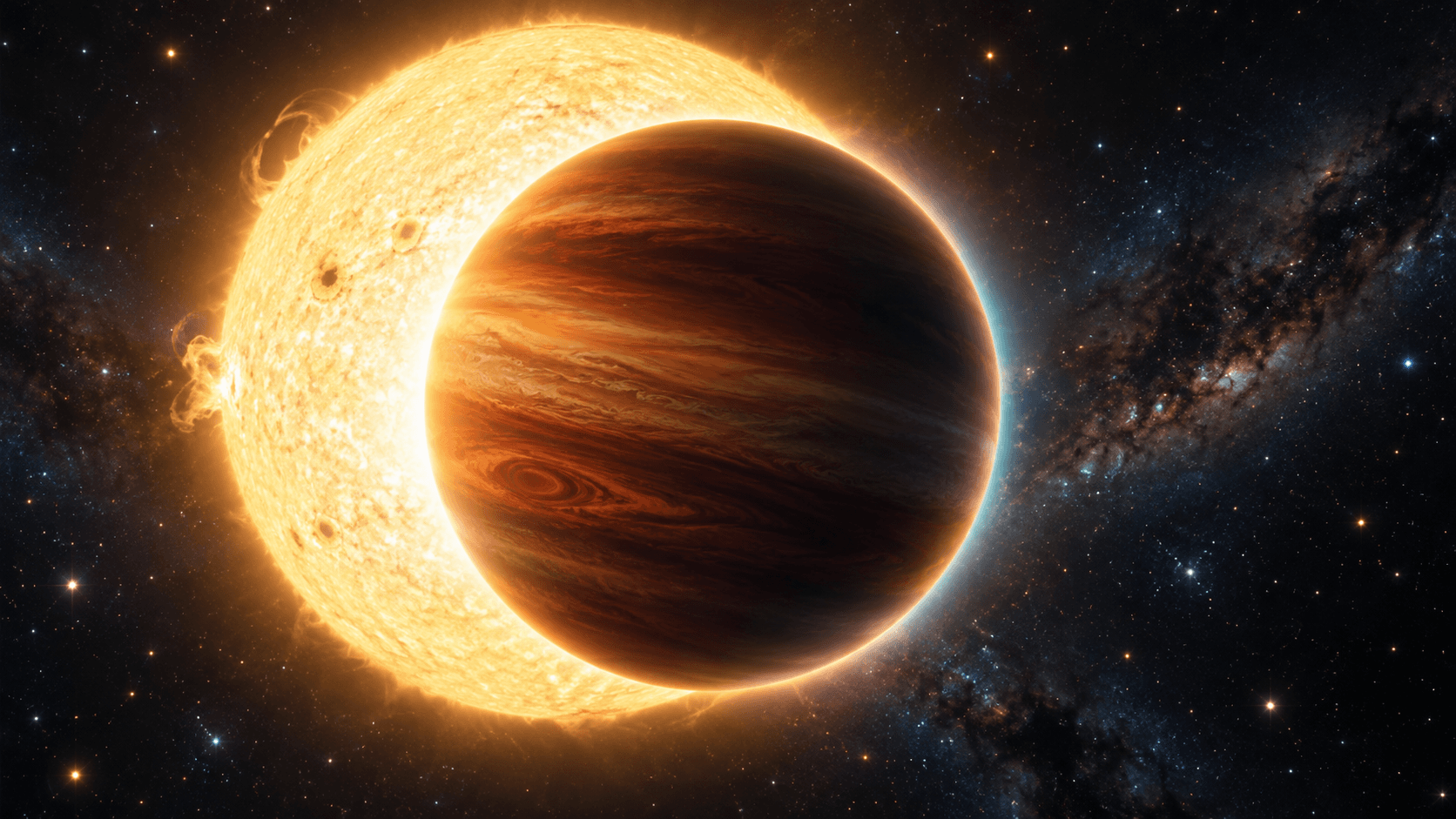
WASP-39b is a hot, inflated gas giant roughly Saturn-like in mass but larger than Jupiter in radius, orbiting its star every four days about 700 light-years away. It is not potentially habitable. Its scientific importance comes from its puffy atmosphere and favorable transits, which let the James Webb Space Telescope produce an unusually detailed chemical portrait. Webb observations revealed a prominent carbon-dioxide feature and evidence for sulfur dioxide created by photochemistry, alongside water, sodium, carbon monoxide, clouds, and other constraints.
The planet's atmosphere is a laboratory for testing instruments and models that will later be applied to smaller, cooler worlds. Its signals are comparatively large, yet interpreting them still requires multiple instruments, independent teams, and physical chemistry. WASP-39b sits within the broader class of hot Jupiters, though its Saturn-like mass places it near the low-mass end of that group.
Discovery and a very short year
The ground-based Wide Angle Search for Planets, or WASP, discovered the planet through transits. Every roughly 4.05 days, WASP-39b passes across its star from our viewpoint. Radial-velocity observations measured the star's wobble and constrained planet mass.
The combination revealed an exceptionally low-density world. It has only around a quarter to a third of Jupiter's mass but a radius larger than Jupiter's. Intense stellar heating slows contraction and may deposit energy deep in the planet, producing an inflated envelope. The planet orbits far closer to its star than Mercury orbits the Sun, with equilibrium temperatures around a thousand kelvin depending on assumptions.
How transmission spectroscopy works
During a transit, most starlight is blocked by the planet's opaque disk. A small fraction passes through the atmospheric limb. At wavelengths absorbed by a molecule, the atmosphere becomes effectively more opaque, making the measured transit slightly deeper. Plotting apparent planet size against wavelength creates a transmission spectrum.
The spectrum is not a simple barcode. Molecular bands overlap. Clouds mute features. Temperature and pressure alter line shapes. Star spots and instrument systematics can change the baseline. Researchers fit a forward model or retrieval framework and compare multiple explanations.
WASP-39b's low gravity and high temperature create a large atmospheric scale height. That amplifies spectral features, making it an ideal early-release target for Webb's NIRSpec, NIRCam, and NIRISS instruments.
The carbon-dioxide detection
Webb measured a strong absorption feature near 4.3 micrometers attributed to carbon dioxide. It was widely described as the first clear, detailed detection of carbon dioxide in an exoplanet atmosphere. The result demonstrated Webb's sensitivity and gave formation clues.
Carbon dioxide is not evidence of life on WASP-39b. The planet is a hot gas giant, and CO2 is expected from atmospheric chemistry. Its abundance relative to water, carbon monoxide, methane, and other species helps constrain metallicity and the carbon-to-oxygen ratio. "Metallicity" in astronomy means the abundance of elements heavier than hydrogen and helium, not a metallic surface.
Heavy-element enrichment can reveal how much solid material the planet accumulated and where it formed. Interpretations depend on chemical equilibrium, mixing, clouds, and possible migration, so one molecule does not uniquely reconstruct the birth location.
Sulfur dioxide and photochemistry
The spectrum also showed sulfur dioxide, an important result because equilibrium chemistry alone did not predict the observed abundance. Ultraviolet light from the star can break hydrogen sulfide and drive reactions that form sulfur dioxide. This is photochemistry — the transformation of an atmosphere by light.
The detection provided evidence that photochemical processes operate in an exoplanet atmosphere. On Earth, ozone is a famous photochemical product; on WASP-39b, sulfur chemistry dominates the relevant story. Sulfur dioxide here is not a volcanic plume directly photographed, nor is it a biosignature.
Models that incorporate vertical mixing and stellar ultraviolet radiation can reproduce the feature and predict other sulfur compounds. Comparing predictions with new wavelengths tests whether the network is complete.
Water, sodium, carbon monoxide, and clouds
Webb and earlier telescopes identified water-vapor features and sodium, while Webb data constrained carbon monoxide and showed little methane under the observed conditions. Potassium claims and other species depend on data sets and confidence thresholds. The page should use the current peer-reviewed inventory rather than turn every retrieval preference into a detection.
The atmosphere is partly cloudy, but the clouds do not form a fully opaque deck at all wavelengths. Cloud composition is uncertain. At these temperatures, silicates or sulfides may contribute depending on altitude and circulation. Transmission samples the day-night boundary, which may differ from the hot dayside and cooler nightside.
A planet in three dimensions
One-dimensional spectra often assume a single temperature and composition around the limb. Real planets have east-west and vertical differences. WASP-39b is probably tidally locked, with a permanent dayside and nightside. Fast winds transport heat and chemicals. Condensates can form on the cooler side, settle, evaporate, and be replenished.
Researchers can compare ingress and egress — the beginning and end of transit — to look for different morning and evening limbs. Phase curves measure brightness through an orbit and constrain heat transport. These subtle measurements turn a global average into atmospheric weather and circulation.
Formation and migration
Gas giants are thought to form where a disk supplies gas and solid material efficiently, often farther from the star than their present hot orbits. WASP-39b likely migrated inward through disk interactions or later dynamics. Its atmospheric elemental ratios retain partial evidence of what it accreted.
Oxygen, carbon, sulfur, and alkali abundances can be compared with formation models involving gas, dust, and icy planetesimals. But migration, core erosion, and interior-atmosphere mixing can blur the record. A retrieval gives atmospheric abundance; translating that into a birth certificate is a separate inference.
Why the planet is inflated
A gas giant cools and contracts with age. Strong irradiation changes the outer boundary and can keep a hot planet larger. Proposed inflation mechanisms include transfer of stellar energy to depth, atmospheric circulation effects, and electrical dissipation in ionized winds. WASP-39b's low density gives large signals while testing these theories.
Mass and radius alone do not show which mechanism dominates. Age, heavy-element content, incident flux, and comparisons with hundreds of other hot giants are needed. Population trends are therefore as important as the individual showcase spectrum.
Is WASP-39b habitable?
No in the ordinary surface-habitability sense. It is a hot gas giant without a known solid surface, exposed to intense irradiation. Temperatures and pressures grow with depth. The molecules in its atmosphere are interesting because they test chemistry, not because carbon dioxide or water automatically signals oceans or organisms.
Speculation about moons should also be restrained. No moon has been confirmed there, close-in giant planets have limited stable regions for satellites, and stellar tides can complicate long-term survival.
Why study an uninhabitable planet?
Large clear signals let scientists validate Webb calibration, compare independent reduction pipelines, improve molecular databases, and test atmospheric retrievals. Techniques proven on WASP-39b can be adapted cautiously to smaller signals. It is the equivalent of learning the instrument on a loud, information-rich target before listening for whispers.
The planet also offers chemistry unavailable nearby. Jupiter and Saturn are cold, while WASP-39b receives extreme light. Its sulfur photochemistry, inflated structure, and global circulation expand comparative planetology beyond Solar System conditions.
What remains unknown
Researchers continue to refine abundances, cloud properties, temperature structure, and three-dimensional differences. They want to know how well one-dimensional retrievals represent a complex limb, how the atmosphere exchanges material with the deep interior, and which formation histories reproduce all elemental ratios.
Future observations can add wavelengths, repeat transits, study eclipses, and compare WASP-39b with other hot Saturns. Repetition also guards against detector systematics and stellar variability.
A closer look at the observing campaign
WASP-39b was selected for Webb's Transiting Exoplanet Community Early Release Science program so that data and analysis experience could benefit the wider community. Several observing modes covered overlapping near-infrared wavelengths. Agreement across instruments increased confidence in broad features, while differences exposed calibration and modeling challenges. Open comparison among teams was part of the scientific result: Webb was being tested as well as the planet.
NIRSpec's prism mode collected a broad spectrum in one observation, while higher-resolution modes resolved narrower structure. NIRISS and NIRCam added complementary coverage. Combining them yielded a more complete molecular inventory than a single instrument could provide. An article graphic can show wavelength coverage schematically, but it must not fabricate an exact spectrum; use published data with permission and attribution if plotting numerical points.
What abundance ratios can reveal
Planetary atmospheres contain clues about formation because solids and gas carry different proportions of carbon, oxygen, sulfur, and other elements at different disk temperatures. A giant that accreted many icy planetesimals may become enriched in heavy elements relative to its star. Carbon-to-oxygen and sulfur-to-oxygen ratios can be compared with migration models.
The interpretation is not one-to-one. Clouds can hide portions of a spectrum, retrievals may trade one abundance against another, and the observable limb may not match the deep atmosphere. Material can settle, mix, or become locked inside the planet. Report ratios with uncertainties and avoid declaring a unique birthplace.
The difference between detection and characterization
Finding WASP-39b required noticing periodic dimming and confirming the gravitational signal. Characterizing it requires extracting changes of tens to hundreds of parts per million across wavelength, calibrating detectors, modeling the star, and solving for atmospheric properties. The second task can continue for decades after discovery.
That distinction explains why a planet found in 2011 became a flagship Webb target in 2022. Discovery establishes that a world exists; characterization asks what the world is like. WASP-39b's unusually favorable geometry bridges those stages and trains the tools needed for more difficult planets.
Common misconceptions to correct
Carbon dioxide does not mean the planet has a breathable or Earth-like atmosphere. Sulfur dioxide does not prove active volcanoes, because photochemistry can make it high in the atmosphere. Water vapor does not imply a liquid ocean, and "Saturn-mass" does not mean the planet has Saturn's rings. No rings have been established, so the hero illustration should omit them.
Likewise, a temperature quoted for the planet is usually an equilibrium or atmospheric estimate, not a thermometer reading at a solid surface. A gas giant has changing pressure and temperature with depth and no known accessible surface boundary.
Frequently asked questions
What did JWST find on WASP-39b?
Webb found a detailed transmission spectrum with carbon dioxide and sulfur dioxide, plus evidence and constraints involving water, sodium, carbon monoxide, clouds, and other chemistry.
Is WASP-39b the first planet with carbon dioxide?
Webb delivered the first clear, prominent CO₂ detection in an exoplanet atmosphere. Phrase historical "firsts" in line with the cited mission release and peer-reviewed paper.
Why is sulfur dioxide important?
Its abundance shows that stellar light drives photochemical reactions, giving direct insight into atmospheric sulfur chemistry.
How long is a year on WASP-39b?
About 4.05 Earth days.
Can WASP-39b support life?
It is an extremely hot gas giant and is not considered a promising habitable environment.
Why is it called a hot Saturn?
Its mass is closer to Saturn's than Jupiter's, while intense irradiation and inflation make its radius unusually large.
Compare featured exoplanets
These six featured worlds sample very different corners of the exoplanet catalog. Distances, masses, and interpretations come from evolving datasets, so treat each row as a snapshot rather than a final answer.
| World | Type | Distance | Orbital period | Notable for |
|---|---|---|---|---|
| TRAPPIST-1 system | Seven Earth-size rocky worlds | ~40 light-years | 1.5 – 19 days | Compact resonant chain; benchmark JWST atmosphere study |
| Proxima Centauri b | Roughly Earth-mass candidate | ~4.24 light-years | ~11.2 days | Closest known exoplanet; active red-dwarf host |
| Kepler-452b | Possible super-Earth (status debated) | ~1,400 light-years | ~385 days | Sun-like host; low-signal transit whose planet status is contested |
| K2-18b | Habitable-zone sub-Neptune | ~120 light-years | ~33 days | Webb spectrum shows CH₄ and CO₂; DMS/DMDS claims contested |
| WASP-39b | Hot Saturn | ~700 light-years | ~4.05 days | First clear CO₂ detection; SO₂ photochemistry with JWST |
| 51 Pegasi b | Prototype hot Jupiter | ~50 light-years | ~4.23 days | First confirmed planet around a Sun-like star (1995 Nobel-cited discovery) |
More featured exoplanets
TRAPPIST-1 system
Seven Earth-size rocky worlds orbit an ultra-cool dwarf 40 light-years away. Three sit near the habitable zone, and JWST is measuring their atmospheres one by one.
Proxima Centauri b
A roughly Earth-mass planet orbiting the nearest star to the Sun, discovered by radial velocity. It sits in the habitable zone but faces frequent stellar flares.
Kepler-452b
A statistically validated super-Earth candidate in the habitable zone of a Sun-like star ~1,400 light-years away. Its low-signal detection is now debated.
K2-18b
A habitable-zone sub-Neptune ~120 light-years away. JWST detected methane and carbon dioxide; tentative DMS/DMDS signals remain debated.
51 Pegasi b
The first exoplanet confirmed around a Sun-like star. Its 1995 discovery by Mayor & Queloz shared the 2019 Nobel Prize in Physics.
Sources and further reading
- NASA/ESA/CSA Webb (2022) — WASP-39b atmosphere releases — last verified 2026-09-17
- JWST Transiting Exoplanet Community Early Release Science — WASP-39b overview (Nature) — last verified 2026-09-17
- Alderson et al. (2023) — JWST NIRSpec G395H analysis of WASP-39b — last verified 2026-09-17
- Tsai et al. (2023) — Photochemically produced SO₂ in the atmosphere of WASP-39b — last verified 2026-09-17