
Proxima Centauri b
Learn what astronomers know about Proxima Centauri b, the nearest known exoplanet: its orbit, discovery, possible climate, atmosphere, and habitability.
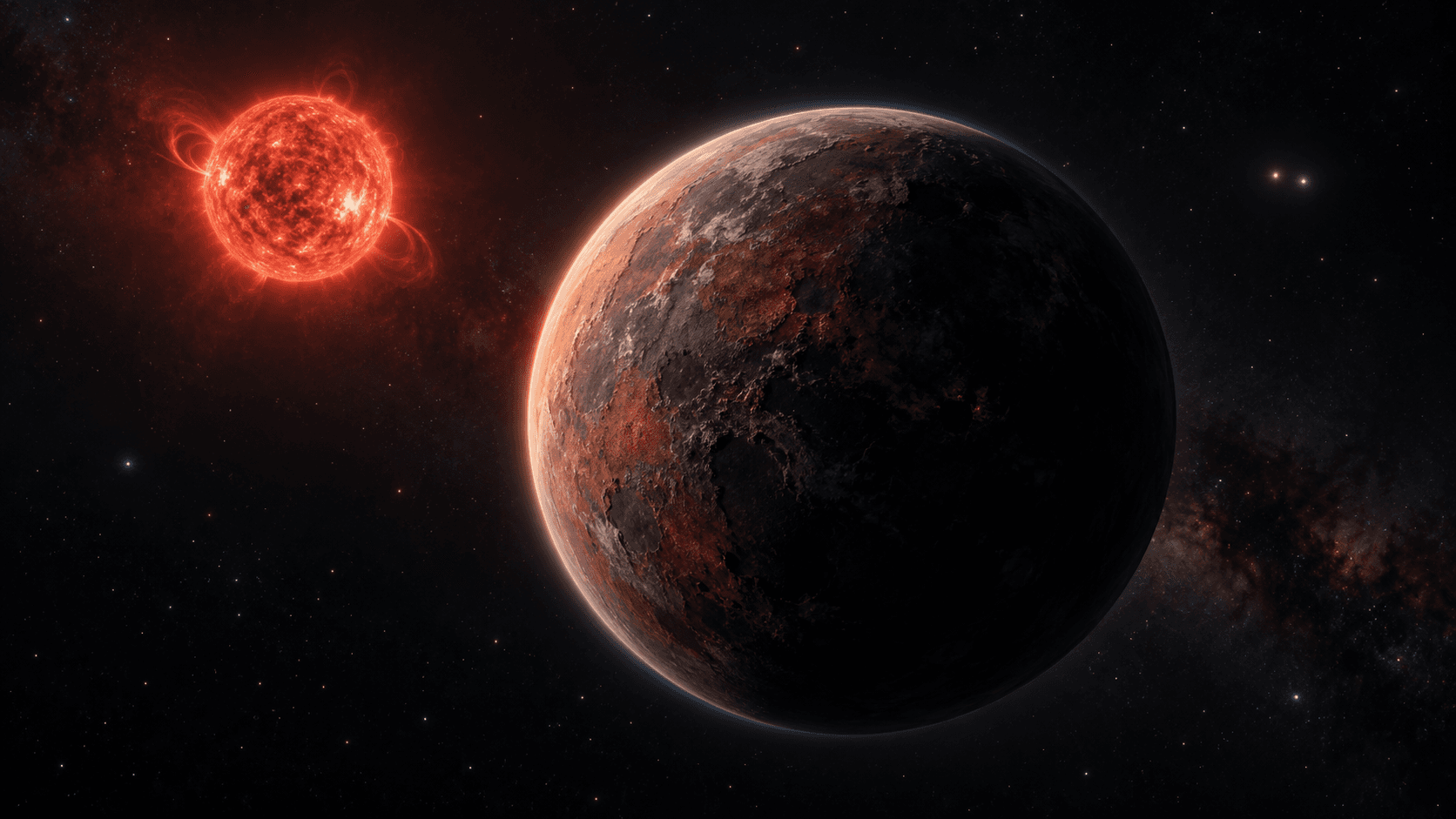
The nearest known exoplanet
Proxima Centauri b is the closest known exoplanet to the Solar System. It orbits Proxima Centauri, the nearest star to the Sun, roughly 4.24 light-years away. The planet has a minimum mass near Earth's and completes an orbit in about 11.2 days. It receives an amount of stellar energy that places it in the star's broad habitable zone, but that fact alone does not make it habitable. The planet does not produce known transits, so its radius, density, atmosphere, surface, and true mass remain uncertain.
Proxima Centauri is a small red dwarf and a member of the wider Alpha Centauri system. It is gravitationally associated with the brighter Sun-like stars Alpha Centauri A and B, though it lies far from that central pair. From a hypothetical surface, A and B would appear as bright neighboring stars, not as two suns dominating the daytime sky.
How Proxima Centauri b was discovered
The planet was announced in 2016 after astronomers combined high-precision radial-velocity measurements, including data from the HARPS spectrograph at the European Southern Observatory. The "Pale Red Dot" campaign monitored Proxima's spectrum for a repeated Doppler shift. A planet and star orbit a common center of mass, so the star alternately moves slightly toward and away from Earth. Its spectral lines shift blueward and redward in a cycle.
The signal repeated about every 11.2 days. Researchers had to separate a planetary pull from stellar activity, which can change spectral lines as spots, magnetic regions, and convective effects rotate across a star. Additional observations have continued to test and refine the signal. Radial velocity provides a minimum mass, written as mass multiplied by the sine of orbital inclination. Without a transit or another inclination measurement, the true mass could be higher.
What is actually measured
The orbital period and velocity signal are the strongest direct constraints. Models also estimate the planet's orbital distance and the energy it receives from the star. Its mass is not an exact Earth mass, and its radius has not been measured. Illustrations showing continents, oceans, ice, or clouds are possibilities, not observations.
If the orbit is oriented close to edge-on, the true mass stays near the measured minimum and a rocky composition is plausible. A more face-on orbit would imply a larger mass. Statistical arguments favor neither the extremely face-on geometry nor a precise rocky radius for an individual planet. Responsible descriptions therefore call Proxima b a roughly Earth-mass planet or terrestrial candidate, not "Earth's twin."
The habitable-zone question
A habitable zone is the range where a rocky planet with a suitable atmosphere might maintain liquid water at its surface. Proxima b receives broadly Earth-like stellar energy, but its star's light is redder than sunlight. Ice, atmospheric gases, and clouds absorb and reflect that spectrum differently, changing climate thresholds.
Climate simulations show multiple possible outcomes. With enough atmospheric pressure and effective heat transport, a tidally influenced planet could avoid global atmospheric collapse and maintain liquid water in some models. With little atmosphere it could have extreme surface temperatures. A thick carbon-dioxide atmosphere could warm it; too much greenhouse effect could overheat it. Its initial water inventory and billions of years of atmospheric loss are unknown.
The phrase "in the habitable zone" is therefore a statement about orbit and hypothetical climate, not evidence of present water or life. Habitability also depends on chemistry, geologic cycling, stellar particles, magnetic protection, and long-term stability.
Red-dwarf flares and atmospheric survival
Proxima Centauri is magnetically active. It produces frequent flares and occasional powerful events that increase ultraviolet and X-ray radiation. High-energy photons heat upper atmospheres, while stellar winds and energetic particles can drive chemical change and escape. Because Proxima b orbits very close to the star, it experiences a space-weather environment unlike Earth's.
That does not allow a simple conclusion that its atmosphere must be gone. Escape depends on atmospheric composition and mass, the planet's gravity, magnetic field, replenishment by volcanism, impact history, and the star's evolution. Some models remove large water inventories; others preserve substantial atmospheres under selected initial conditions. A thick atmosphere can survive processes that strip a thin one, and an atmosphere lost early may be partly replaced later.
Flares can also provide ultraviolet energy that drives prebiotic chemistry in certain scenarios. The balance between harmful erosion and useful chemistry cannot be summarized as "flares make life impossible." Observations of the star across radio, optical, ultraviolet, and X-ray wavelengths help define the environment that climate models must confront.
Is Proxima b tidally locked?
Strong tides probably altered its rotation. Synchronous rotation, in which one hemisphere continually faces the star, is plausible, but other spin-orbit states may be possible depending on orbital eccentricity, internal structure, and history. Even a synchronized world need not have an atmosphere frozen permanently on the nightside. Winds and oceans can redistribute heat if they are substantial enough.
Clouds over the continuously illuminated region might reflect incoming energy and expand the inner edge of habitability in some models. Other models yield a warm substellar ocean surrounded by ice, a dry hot landscape, or an airless world. These scenarios illustrate physical possibilities; they are not maps of Proxima b.
Does Proxima Centauri b have an atmosphere?
No atmosphere has been confirmed. Because the planet is not known to transit, ordinary transmission spectroscopy cannot be used. Astronomers instead consider reflected-light spectroscopy, thermal emission, high-resolution separation of planet and star spectra, radio searches, and future direct-imaging techniques.
The close angular separation between the planet and star is difficult, but proximity helps: Proxima is far nearer than most exoplanet hosts. Extremely large ground-based telescopes may seek molecular signatures by combining adaptive optics, coronagraphy, and high-dispersion spectroscopy. Future space observatories could improve contrast and stability. A detection would still require careful removal of telluric absorption, stellar variability, and instrumental systematics.
Other planets and signals around Proxima
The system has generated additional planet claims and candidates, including a short-period inner world commonly called Proxima d. A proposed outer companion, Proxima c, has had a more complicated observational history and should not be presented with the same confidence as Proxima b without checking the current archive. This distinction is important: candidate status can change as stellar activity and new data are analyzed.
Multiple planets would help reveal the system's formation and supply dynamical constraints. The wide relationship between Proxima and Alpha Centauri A and B may also have influenced the original disk, though models explore many histories. Keep the article's central focus on Proxima b and link to a live system catalog for changing details.
Could life exist there?
There is no evidence of life on Proxima b. Habitability arguments begin with conditional statements: if the planet is rocky, if it retained a suitable atmosphere, if it has water, and if its climate remains stable, then some environments might support chemistry associated with life as we know it. Each "if" represents an open measurement.
A future spectrum containing oxygen would not by itself settle the question. Water loss can leave oxygen behind, and photochemistry around red dwarfs can produce false positives. Methane can arise biologically or geologically. Scientists would look for combinations of gases out of chemical equilibrium, surface and cloud context, seasonal or temporal behavior, and plausible nonbiological alternatives.
How long would it take to get there?
At 4.24 light-years, even the nearest exoplanet is enormously distant. Light takes 4.24 years to arrive. Voyager 1's speed, if pointed in the right direction, would imply a journey of tens of thousands of years. No current spacecraft can carry people there, and Proxima is not Voyager's destination.
Concepts such as laser-driven light sails propose accelerating tiny probes to a significant fraction of light speed. A journey might then take decades rather than millennia, but the system would require unprecedented lasers, lightweight sails, precision aiming, protection from interstellar dust, communication across light-years, and some way to collect useful data during a fast flyby. Crewed travel is far beyond demonstrated engineering.
What a direct image would mean
Direct imaging would not initially produce a detailed globe. At interstellar distances, the planet would likely remain an unresolved point separated from the star's glare. The point's brightness and spectrum could reveal reflectivity, temperature, atmospheric molecules, clouds, and perhaps rotation or seasonal changes.
Different wavelengths probe different gases and altitudes. Repeated measurements would matter more than a single colorful rendering. Any published artist's concept must be labeled, because no telescope has photographed the planet's surface.
Why Proxima Centauri b matters
Proxima b is a test of how well potentially temperate rocky planets survive around active red dwarfs — the most common class of star in the Milky Way. Its proximity makes ambitious future observations conceivable. It also forces astronomy to confront stellar noise: the same activity that threatens an atmosphere can imitate or obscure the velocity and spectral signals used to study the planet.
The planet is compelling precisely because the evidence is incomplete. We know a nearby world tugs on the nearest star with an 11-day rhythm. We do not yet know whether it resembles a scorched rock, a frozen world, a cloudy ocean planet, or something outside familiar categories.
How astronomers avoid confusing activity with a planet
Red dwarfs make radial-velocity work difficult because dark spots, bright magnetic regions, and changing convection can shift or distort spectral lines. Researchers compare the 11.2-day velocity signal with indicators of magnetic activity and with the star's rotation period. They observe at different wavelengths, because a true gravitational wobble should remain consistent while spot-driven signals can change color and evolve. Long time baselines test whether the phase remains coherent. This work matters not only for Proxima b: the methods developed here help searches for small planets around other active stars.
Proxima's brightness and closeness permit exceptionally detailed monitoring, but they do not eliminate uncertainty. Articles should distinguish the secure planetary period from more model-dependent statements about eccentricity, mass, and neighboring candidates.
Frequently asked questions
Is Proxima Centauri b the closest exoplanet?
It is the closest confirmed exoplanet currently known, orbiting the nearest star to the Sun about 4.24 light-years away.
Is Proxima Centauri b habitable?
It lies in a broad habitable zone, but its atmosphere, water, radiation history, surface conditions, and true mass are not known. Habitability is unconfirmed.
Does Proxima b transit its star?
No convincing transit has been established. Without transits, astronomers cannot directly measure its radius using the usual transit method.
Could humans live on Proxima b?
There is no evidence that its environment is safe or even has a surface atmosphere. Interstellar travel to it is also beyond present technology.
How was it found?
It was detected through radial velocity — a repeating Doppler shift in Proxima Centauri's spectrum caused by the planet's gravitational pull.
How long is a year there?
One orbit takes about 11.2 Earth days.
Compare featured exoplanets
These six featured worlds sample very different corners of the exoplanet catalog. Distances, masses, and interpretations come from evolving datasets, so treat each row as a snapshot rather than a final answer.
| World | Type | Distance | Orbital period | Notable for |
|---|---|---|---|---|
| TRAPPIST-1 system | Seven Earth-size rocky worlds | ~40 light-years | 1.5 – 19 days | Compact resonant chain; benchmark JWST atmosphere study |
| Proxima Centauri b | Roughly Earth-mass candidate | ~4.24 light-years | ~11.2 days | Closest known exoplanet; active red-dwarf host |
| Kepler-452b | Possible super-Earth (status debated) | ~1,400 light-years | ~385 days | Sun-like host; low-signal transit whose planet status is contested |
| K2-18b | Habitable-zone sub-Neptune | ~120 light-years | ~33 days | Webb spectrum shows CH₄ and CO₂; DMS/DMDS claims contested |
| WASP-39b | Hot Saturn | ~700 light-years | ~4.05 days | First clear CO₂ detection; SO₂ photochemistry with JWST |
| 51 Pegasi b | Prototype hot Jupiter | ~50 light-years | ~4.23 days | First confirmed planet around a Sun-like star (1995 Nobel-cited discovery) |
More featured exoplanets
TRAPPIST-1 system
Seven Earth-size rocky worlds orbit an ultra-cool dwarf 40 light-years away. Three sit near the habitable zone, and JWST is measuring their atmospheres one by one.
Kepler-452b
A statistically validated super-Earth candidate in the habitable zone of a Sun-like star ~1,400 light-years away. Its low-signal detection is now debated.
K2-18b
A habitable-zone sub-Neptune ~120 light-years away. JWST detected methane and carbon dioxide; tentative DMS/DMDS signals remain debated.
WASP-39b
A hot Saturn-mass giant ~700 light-years away. JWST returned the first clear CO₂ detection and evidence of SO₂ photochemistry in an exoplanet atmosphere.
51 Pegasi b
The first exoplanet confirmed around a Sun-like star. Its 1995 discovery by Mayor & Queloz shared the 2019 Nobel Prize in Physics.
Sources and further reading
- Anglada-Escudé et al. (2016), Nature — discovery paper — last verified 2026-09-17
- European Southern Observatory — Pale Red Dot and Proxima b — last verified 2026-09-17
- NASA Exoplanet Archive — Proxima Centauri b system parameters — last verified 2026-09-17
- NASA Exoplanet Exploration — Proxima Centauri b — last verified 2026-09-17